
The parenting series · Part 7 of 7
Parenting Advocacy: What to Have in Your Folder
A school meeting is one of the few places where somebody's job includes hearing you out. That changes what is worth preparing.
There is a particular quiet in the car before a school meeting.
Beside you is the folder. Yours might be an actual folder, with reports in it and emails you printed. It might be a note on your phone, or a thread you know how to find, or photographs from the weeks when things were hardest. It might be nothing you could hand to anyone. Just everything you have worked out about your child, held in your head because there was never a good time to write it down.
Whatever shape it takes, the folder holds the same three things: what you understand about your child, what you have already asked for, and what has actually helped.
You also have the thing you meant to say, rehearsed in a version where everyone was reasonable. And underneath that, the fear that you will be pleasant for an hour and nothing will change.
Most of the time, something does change. Rarely everything, and often not the part you wanted most. What you get out of a school meeting depends less on how strongly you feel than on how well one page survives someone who knows your child less than you.
So here is the shape of it. The folder is for you. One page on top of it is for them. Building that page is a move you can repeat, in any room where somebody is in a position to change something for your child. A school meeting is just where it is easiest to see.
Why a school meeting is the clearest case
The folder goes everywhere with you. To the pediatrician. To your mother's kitchen. To the birthday party where another parent asks a careful question and you have four seconds to decide how much to say.
This is the only one of those rooms where somebody's job includes opening it with you.
Not warmly, and not quickly, and not always well. But there are people whose work involves listening to you, and processes that have to answer in some form, and words that still exist after everyone has gone home. That is unusual. Most of the explaining a parent does happens in places with none of it.
It helps to see where you are standing. Picture the people around your child as a set of rings. You and your child at the center, then whoever is close to you, then school and systems, then strangers at the edge.
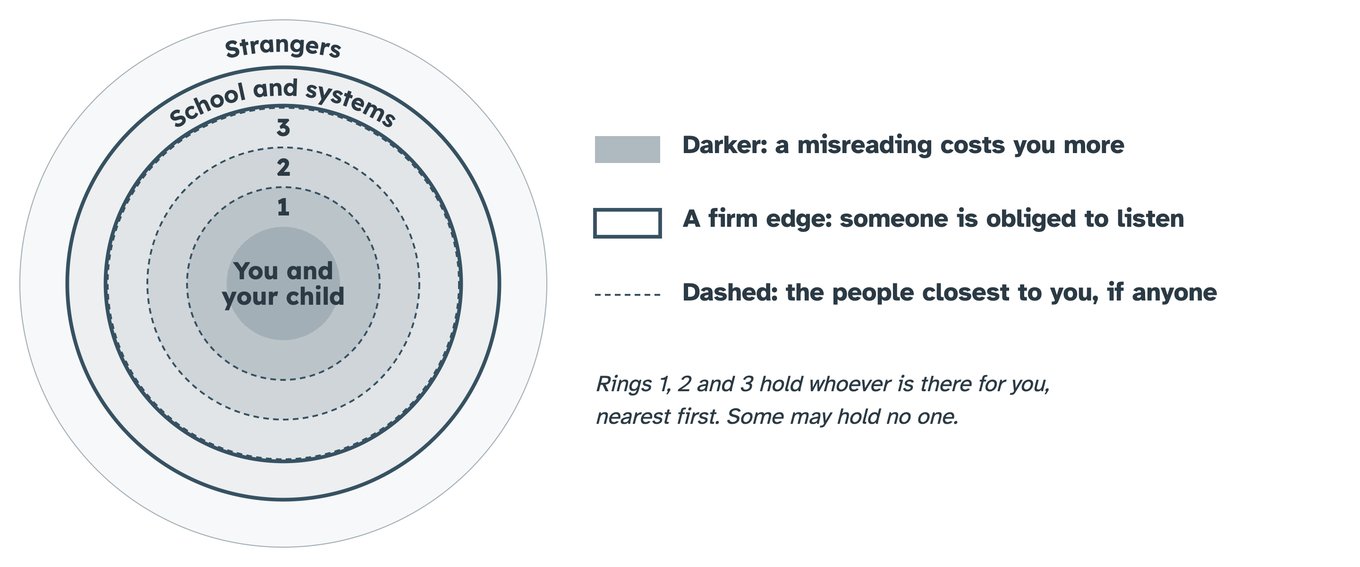
It cuts both ways.
It means how you ask matters more here than it does at home. An explanation that comes out clumsy at your own kitchen table usually gets another go. Not because family is gentler about it, but because you will be in that kitchen again next week. Here you may get one pass, with somebody who has twenty-nine other children and a form to finish.
And it means a page in writing lasts in a way the same words out loud do not. A conversation in the hallway was real and warm, and in March nobody will be able to find it. That is not cynicism about schools. It is how institutions remember anything at all.
That is what makes it the clearest case, and why it is worth practicing here. What you learn doing this is what you will use at the pediatrician's. And in the email to the coach, and the next time a specialist has twenty minutes. The room changes. The move does not.
What is in the folder is for you
The folder is not a case you are going to argue. Nobody at that table has read it, nobody at that table has time for it, and handing over more of it does not make you more believable.
That does not make it wasted. It makes it yours.
What is in that folder is what makes you the person who knows which moment matters. It is why you can be specific when somebody who met your child in September cannot be. And each of its three parts does a particular job for the page you are about to write.
What you understand about your child tells you which moment to name. You have watched the whole year. You know the hard part is not the reading, it is the reading out loud, and that it started in a particular week.
What you have already asked for keeps you from spending this meeting on something that was settled last spring. If a seat change was refused in October, you are not going to open with it in January. You have other things to ask for.
What has actually helped is where your request comes from. You know what works at home, or worked last year, or worked for three weeks until the schedule changed. That is not a guess. It is the most specific information in the room.
So the folder is already doing all of that before you say a word. One page goes on top of it, and that page is for them.
The page on top
Of everything in that folder, what faces outward?
One page, carrying one problem and one request. The useful thing about it is that it does not change as it travels. What changes is who can act on it, and what you are asking them to do.
The method comes from the psychologist Ross Greene, and one distinction is the whole of it: separate the skill from the problem.
A skill is the general thing your child can reach on some days and not others — moving from one thing to the next. It explains a great deal, and nobody can put it on a schedule.
A problem is one specific moment, with a time and a place in it — getting off the tablet at eight on school nights. It explains much less, and somebody can actually change it.
The difference is what each one hands to the person across the table. Give them a skill and they have an account of your child. Give them a problem and they have something to try on Tuesday. Both are true. Only one of them is work that can be started this week.
So the page on top carries a problem, not a skill. Not because the skill is the wrong idea. The skill is yours to understand; the problem is theirs to do something about.
Four things that keep the top page usable
Greene is precise about the wording, and he is right to be, because a badly worded problem falls apart before the conversation starts. Four things to get right. Each one is a way the page stops being usable by somebody who was not there.
1. Take the behavior out. You are not going to open with the worst thing your child did, so it does not belong on the page. Shouts and shoves in the lunch line becomes difficulty waiting in the lunch line. Almost every one of these starts with difficulty and then a verb.
2. Take your theory out. However sure you are about why — and you may well be right — it makes the page unusable. Difficulty with the reading group because the teacher singled him out in September is two claims, and only one of them can be worked on. Difficulty reading aloud in the reading group.
3. Split it; do not clump it. Difficulty with transitions cannot be acted on by anybody. Difficulty coming in from the playground after lunch break can. If your page covers more than one moment, you have more than one page.
4. Make it specific enough to picture. Who, what, where, when. The test: could somebody who has never met your child see the moment? If not, add the detail that would let them.
There is a short list of words that look like tasks and are really verdicts. Listening. Paying attention. Staying calm. Asking for help. Trying. Nobody can act on those, including your child. If your page contains one, there is a particular moment underneath it that has not been named yet, and naming it is the work.
When you cannot name it yourself
A lot of the time you will not be able to do this, and that is not a failure of advocacy.
The year is a blur. You know something is wrong and not which part. You can see that pickup goes badly and genuinely not know whether it is the noise, the handover, the friend who moved away, or that lunch was at eleven. Working out the specific moment is itself hard work, and nobody handed you training in it.
So here is the part worth keeping: those four rules are not only yours to meet. They are a fair standard for anybody in that building whose job involves your child.
When a report says difficulty with transitions, or needs to try harder, or does not use his strategies, those are skills and verdicts — not problems. Nobody can act on them either. So you can ask of them exactly what you would ask of yourself. Which moment? What time of day, in what room, doing what?
You do not have to arrive with the answer. You can arrive with the question — and ask the people who see your child all day to help you find the moment. That is still the move. It is being run from the other end.
Why the wording carries the weight
One well-worded problem your child keeps facing is the least it takes to be believed by somebody who can make a difference in your child's day-to-day life.
It does not ask anyone to agree with you about your child. It does not ask them to have read anything, or to like you. It names one moment, in words they can picture, that they are in a position to do something about.
That is doing more work than it looks like. The person across the table has a few minutes of your child and a view already half formed. Their expectations fit most children and may not fit yours.
The meeting might be about reading, or a hard year, or something nobody has a name for yet. None of that has to be settled for one page to land.
And it is not malice. It is the ordinary way two minds miss each other, running in both directions. They misread your child; your child reads them as unsafe before anyone has said a word.
The folder changes every year. The page on top is the same move every time. The one that worked on a Tuesday at home is the one for an email in March.
And here is why it is worth learning rather than improvising. It does not ask you to be at your best, and it does not ask them to be at theirs. No eloquence, no argument, no good night's sleep. That is the difference between something you can rely on and something you have to rise to.
What is settled about this, and what is not
It is worth saying plainly which parts of this have been studied and which have not.
Greene's approach has a research base, reviewed across families, schools and treatment facilities. The part that holds up best is the general move rather than any particular phrasing: a specific, agreed-on problem gets worked on more often than a general trait does.
And nobody can tell you whether a given meeting will go well. Who is across the table, what month it is, how much is already on their desk. None of that is yours to control, and none of it can be predicted from here. What is yours is whether the thing you hand over can be acted on at all. That is a smaller claim than a promise, and it is the one we can stand behind.
Sending the page
When the page goes into an email, two things happen that do not happen out loud. It becomes something a person can forward to somebody who was not there. And it is still there later, when the person you spoke to has moved on.
So the email is short, it carries the problem, and it names the one thing you would like tried. Not five things. One — because a single specific request is answerable, and a list is a negotiation.
What you ask for is smaller than you expect. What helps a child in a hard moment is usually a change to the setting, not a change to the child. Ten minutes of warning, a different seat, a way to leave a room, starting the goodbye earlier.
This is where the folder has already done the work. You are not inventing a request. You are naming the thing you have watched help.
What makes those happen is rarely force of argument. It is that somebody could picture the moment and had something obvious to try.
And if a particular meeting ends without much: the page is written down, and you will be back. Being on the record is not the same as being heard yet.
When the folder stays shut
Not every person who misreads your child is somebody to open the folder for, and telling them apart saves you more than any wording will.
The stranger at the counter, or in a grocery aisle, formed a view in four seconds and you will not see them again. Not explaining, there, is a decision and not a failure. Advocacy comes out of the same finite supply as everything else you are doing. The explaining you skip in an aisle on Saturday is the explaining you still have for a parent-teacher conference on Monday.
The other parent at a birthday party is a different person entirely. You will see them next year, and the year after, and your children may end up in the same class. That one gets the page on top — not the folder, not the whole account, just the one you already have.
The page your child will one day write
Children take in more of this than we tend to expect.
They remember which seat they were given, and who asked for it, and whether asking worked. They notice whether the grown-ups in the room talked about them or to them. And they are learning the thing that lasts longest: that a person can ask for something to be changed.
That you can name a difficulty without it being a confession. That you can ask for a different arrangement instead of trying harder at something that is not working. That the asking is ordinary, and sometimes answered.
That is the part that transfers. One day your child writes their own top page, about themselves, in a room you are not in. It has the same shape as the one you are writing now. The practice they get is watching you do it — and then, as they get older, doing more of it with you.
The point
The hard part of a school meeting looks like it needs expertise. It mostly needs one page.
You will not have a script for the next one. It has not happened yet, and the person across the table will be somebody you have never met. None of that matters much if you can do the one move. Name what is hard for your child on some days. Find the specific moment where it keeps going wrong, say it in words somebody who was not there can picture, and ask for one thing to be tried.
The folder stays in your lap. One page goes across the table.
If that sounds like something you would rather not work out alone, that is what we are here for.
The whole series
- 1When Parenting Feels Different From Everyone Around You
- 2Parents First: Why Your Own Care Was Never Optional
- 3Contents Under Pressure (Are to Be Expected)
- 4You Are the Harbor, Not the Rescue Boat
- 5The First People You Have to Convince
- 6Too Soft, Too Hard, and Never Right
- 7Parenting Advocacy: What to Have in Your FolderYou are here
Read next
- Parenting a Child With Complex Needs — the main piece this one sits under, and where the rest of the series starts.
- The First People You Have to Convince — the same move, closer to home: your co-parent and your child.
- Too Soft, Too Hard, and Never Right — when the people judging your parenting are the people who raised you.
- The Double Empathy Problem: It's Not Just You — why misreading runs in both directions, and what that changes.
- Occupational therapy at Bridge — the setting-side work: what changes in a room, rather than in a child.
References
Greene, R. W., & Winkler, J. (2019). Collaborative & Proactive Solutions (CPS): A review of research findings in families, schools, and treatment facilities. Clinical Child and Family Psychology Review, 22(4), 549–561.
Lives in the Balance. (2024). Assessment of Skills and Unsolved Problems (ASUP). Retrieved 23 October 2026. (The wording guidance in this post is our rendering of the instrument's own four rules; nothing of the instrument is reproduced here.)
Milton, D. E. M. (2012). On the ontological status of autism: The 'double empathy problem'. Disability & Society, 27(6), 883–887.