
The Double Empathy Problem: It's Not Just You
Why miscommunication is not one person's fault — and what to actually do about it.
A dog wags its tail because it is pleased. A cat wags its tail because it has had enough.
Put the two of them in one room and watch. The dog reads the signal exactly as a dog should read it, and comes closer. The cat reads that approach exactly as a cat should read it, and leaves. Neither animal missed anything. Each one read the other correctly, by its own grammar, and arrived at the wrong answer.
Every conversation you have runs on rules like that — rules nobody states. How long a pause means you are finished. Whether a raised voice means danger or just enthusiasm. Whether we should do this sometime is a plan or a politeness.
You cannot see those rules while they are working. They become visible only when you are standing outside them — when you are the one in the room who did not get the memo, and everyone else seems to be reading from a script you were never handed.
That experience has a name, and it is kinder than the ones you have probably been using on yourself. It is the double empathy problem, and once you have it, you start seeing it everywhere.
What it actually is
The double empathy problem was first described through autism research, by the autistic scholar Damian Milton (2012). The idea is simple and, the more you sit with it, a little revolutionary:
When two people think and process the world differently, both of them have trouble understanding each other.
Not one broken communicator and one patient listener. Two people, wired differently, each doing their honest best — and each missing the other.
For a long time the story went the other way. Communication trouble was treated as one person's deficit, usually the person whose mind was in the minority. The double empathy problem turns that around. The difficulty is not inside either person. It lives in the space between two different kinds of minds, and it runs in both directions.
It runs both ways
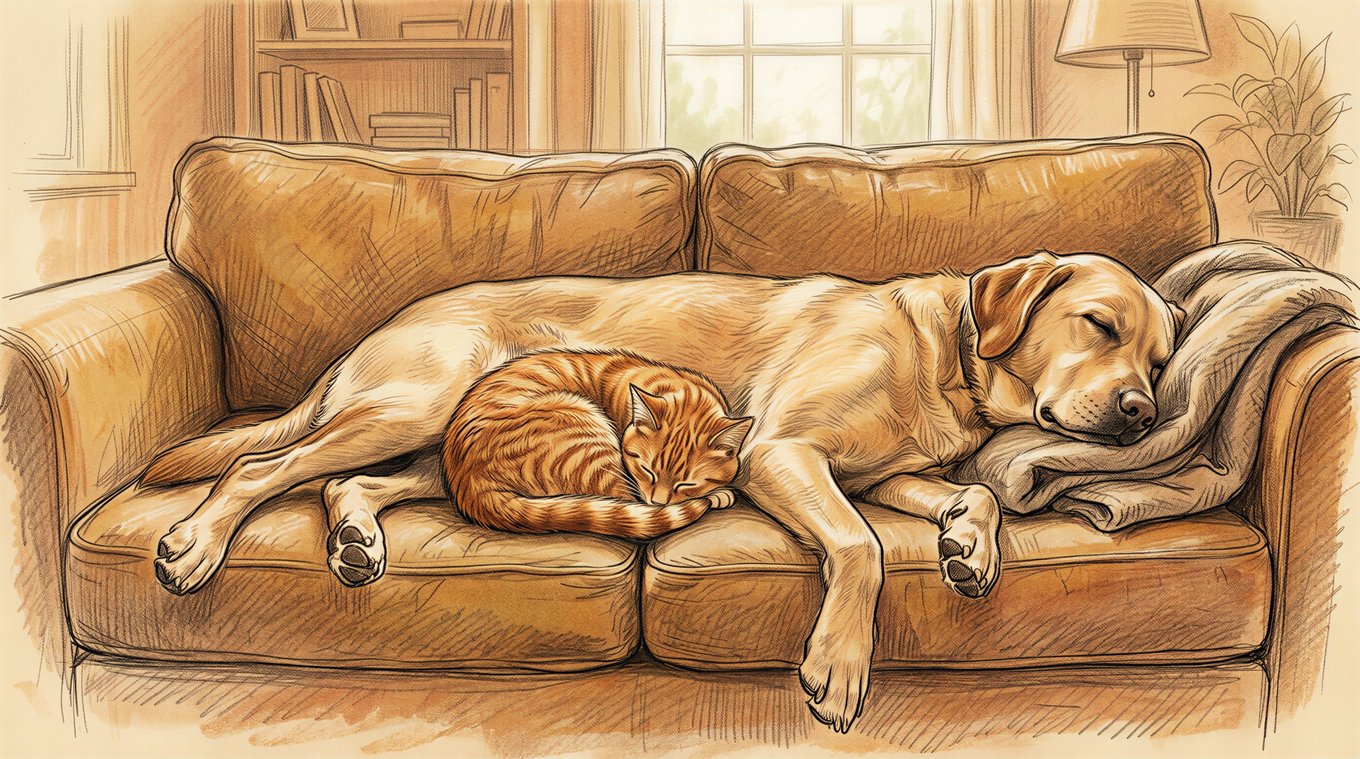
Go back to the room with the cat and the dog in it.
The dog drops into a play bow — front down, back end up, the clearest invitation in its whole vocabulary. The cat sees a creature making itself low and coiled, and leaves the room. Later the cat slow-blinks at the dog, which is about as close to I trust you as a cat gets. The dog sees nothing at all, because to a dog a long look is a question and a closed eye is not a word.
Both of them are fluent. Both are paying attention. Both are wrong.

The cat: Silly dog, don't you know this is my quiet time? I will find a bed.
Two people can both be right about what they heard and both be wrong about each other.
That is not how we usually tell it. We assume that when a message does not land, somebody sent it badly or somebody received it badly. Here the sending and the receiving were both fine. What went wrong happened in between.
But people are not cats and dogs
The picture is useful, and it stops short — and where it stops is the part that matters most.
Nobody tells the cat it is doing it wrong. No one sits the cat down to explain that a tail means something different in this house. The cat is not asked to work on its tail, or to try harder at being legible to dogs, or to account for itself before it can be believed.
And the house is arranged for one of them. Somebody chose the furniture, and the floor, and where the food goes, and how much noise there is, and whether there is anywhere high to sit. One animal finds that arrangement obvious. The other works around it all day. That is not a difference in style. It is a difference in whose defaults the room was built on.
People also pay for the misread in a currency animals do not have. A performance review. A grade. A diagnosis. A marriage. What is a funny story between a cat and a dog is, between two people, a child written up as not trying.
So both of them are misreading each other is true, and both of them are misreading each other equally is not. Mutual is not the same as equal. Both people can be missing each other while only one of them is being asked to account for it.
Where this gets hard to study
A word about the research, because the honest version is more useful than the confident one.
People change when they know they are being watched. That is the oldest problem in studying human beings and there is no way around it. Put two people in a room, tell them you are measuring how well they understand each other, and you have already changed the thing you came to measure.
Which is the joke at the heart of this, and also the point. A conversation where someone feels observed, or weighed up, or at risk of being misread, is not the same conversation as one where they do not. That is not a flaw in the method. That is the phenomenon. It is the thing this whole idea is about.
So yes: the evidence is young, it is contested, and some early findings have not reproduced the way people hoped. We would rather say that than hand you a tidier story.
But there is a second thing to say, and the people who built this idea say it more bluntly than we would dare. In a 2026 paper, the researchers behind most of the work above — including Milton himself — argue that measuring this idea by the standards of cognitive science is asking the wrong question of it. It was never offered as a laboratory finding about individual minds. It is a sociological claim about what happens between people, and they warn that making a relational theory answer to individual-level, deficit-oriented metrics risks "distorting it" (Kilgallon et al., 2026).
And they do not wave the evidence away — they engage it. The same paper argues there is growing evidence for the version of the idea it defends, while the traditional deficit-based accounts of social cognition it competes with carry serious problems of their own, of validity and of evidence. It also sets out two narrower, probabilistic claims that add nuance to the assumption that same-neurotype conversation will always go better than mixed — which is the honest way to hold the 2025 result above, rather than as a verdict in either direction.
That is not special pleading, and you can check it against your own week. A lens is useful when it shows you something you can then go and look at. This is a lens to think with, not a verdict to cite.
None of that means the research has nothing to hand you. One result is worth carrying, and it is the one you can act on. Telling people your diagnosis improved rapport (Crompton et al., 2025). Not explaining your processing. Not educating anyone. Just being known. We come back to it at the end.
And here is what we see in our own practice, offered as that and not as proof. The information usually crosses. The meaning does not. The words arrive intact and then something happens to them on the way in — the same sentence heard as cold, or as an excuse, or as not really trying. When rapport is thin, interpretation thins with it.
The mind-reading myth
Every animal is fluent in its own signals and badly overestimates its range. So are we.
We are mostly good at reading the minds of people who are already like us. We read faces, tones and intentions more accurately when they come from someone who shares our wiring, our background, our reference points. Get outside that circle and the accuracy drops — you catch the gist and miss the puns.
Which is worth saying plainly, because a whole social expectation is built on top of the myth. We treat it as normal — even polite — to expect people to just know what we mean without our saying it. That expectation quietly assumes everyone is running the same rules, and it hands a penalty to anyone who is not. I would put it this way: the demand to be mind-read is, underneath, a little bit ableist. That word gets used far more often than it gets explained, so — ableism is the assumption that there is one right way for a mind to work, and that everything else is a lesser version of it. A social rule expecting everyone to read a room the same way has that assumption built into it, whether anyone meant to put it there or not.
And the version that does the most damage is the one you turn on yourself. Disability scholars call it internalized ableism — the majority's verdict on you, taken inside until it feels like the truth about you (Campbell, 2009). It is the shadow of what this whole piece is arguing. It is the space between, not you — and internalized ableism is what happens when the space between gets folded inward.
Which is also why the gap is loudest at a border. Between two people who both sit in the majority it is a small friction, quickly repaired. Between someone in a minority and the majority around them it is louder, more frequent and more expensive — because one side can go a whole life without ever needing to cross, and the other cannot. Disabled activists worked this out long before anyone thought to study autistic communication, and we have written about that inheritance properly in Meet Me a Quarter of the Way.
The generous move is the opposite one — to say the thing, and to ask.
It is not just autism
Here is the part people assume we are overreaching on, and we are not: the researchers say it themselves.
The double empathy problem was named in autism, and that is where it has been studied. But the 2026 paper describes it as an account of interaction "between individuals with differing dispositions" generally, and says plainly that it "likely also extends to dynamics involving other forms of neurodivergence (e.g., ADHD, schizophrenia, etc.) and intersecting identities" — naming race, gender and class (Kilgallon et al., 2026).
So this is not us borrowing a disability idea and stretching it. It is a sociological idea that happened to be measured in autism first, because that is where the difference was sharp enough, and judged harshly enough, to get the attention.
And every room is arranged for somebody. Open-plan offices suit people who are not pulled apart by noise. Small talk suits people who find it restful. Interviews suit people who think out loud in real time. None of that was chosen to exclude anyone. It was chosen by people for whom it was already comfortable, which is how a default gets made.

The dog: Best spot in the house. Warm floor, the whole rug, everything right where it should be.
That is the correction the authors insist on hardest. Both people in a gap may be misreading each other, and that does not mean they carry it equally. One of them usually has the furniture arranged in their favor: whose way of talking counts as normal, whose confusion is a quirk rather than a failing, who pays for the misunderstanding and who merely finds it irritating.
Where the idea comes from
Worth saying, because it is not ours and it is older than it looks.
The double empathy problem came out of sociology, not psychology — and its authors name their own parents: social constructionist thought, symbolic interactionism, Alfred Schutz's phenomenology, and Harold Garfinkel's ethnomethodology (Kilgallon et al., 2026).
Garfinkel is the one worth knowing about. Back in the 1960s he was studying what he called background expectancies — the thousands of unspoken assumptions that let two people understand each other without anyone explaining anything. His point was that these rules are invisible to the people following them, and become visible only to someone standing outside them.
Which is the whole thing, decades early. The rules of a house are easiest to see from the position of whoever it was not built for. That, more than anything, is why this got noticed and measured where it did.
What this does not mean
The idea is useful enough to be worth protecting from its own misuse, so here is the guardrail, plainly.
A tail explains a misread. It does not explain a bite.
The double empathy problem explains a reading gap. It does not dissolve the difference between a misunderstanding and a harm, and it must never be used to. Two people can understand each other perfectly and still be in real conflict. Some positions are simply wrong. Reading each other differently is not a defense for cruelty. When somebody reaches for the language of difference to explain away what they did — you just do not understand me — the frame is being used as cover. The right response then is not more empathy for the frame. It is to name the harm.
This matters most at home. The closest relationship is the one with the least distance and the most at stake, which makes it the likeliest place for we just read each other differently to be doing work it was never meant to do. If what is happening is a harm rather than a misreading, better information will not close that gap, and more understanding is not the thing that helps.
And it does not work as an accusation either. You are expecting me to read your mind is the same frame turned around, and it can be picked up as a charge just as easily as an excuse. The idea describes a gap between two people. It cannot tell you which of them is in the wrong — that is not something it knows.
Telling the two apart is the whole skill, and needing help to do it is ordinary.
What this changes
Understanding the double empathy problem does one very freeing thing: it retires two exhausting questions.
What is wrong with them? and What is wrong with me? — both assume the trouble lives inside a person. The double empathy problem relocates it to the space between. So the questions get better:
- How might we be processing this differently?
- What is one adjustment each of us could make?
- Where is the actual gap — and which side am I standing on?
That colleague who never seems to get your jokes may be hilarious in a register you do not speak. The friend who explains things in what feels like the most roundabout way imaginable may be walking a perfectly logical path — just not the one you would have taken.
What to actually do
None of these are about becoming someone else. They are about making the gap smaller from your side, on purpose.
1. Say the quiet part out loud. Narrate your own processing instead of hoping it is legible. "I think in pictures — give me a second to put this into words." "I need the big picture before the details land." You are handing the other person your operating manual. Most people are relieved to get one. This is the disclosure finding, come back round. The version of it that was actually tested is narrower than the advice — in that 2025 study, what lifted rapport was people being told a diagnosis. Narrating how you think has not been measured. The advice stands on its own legs; the evidence is for the smaller version of it.
2. Trade the route, not just the verdict. When someone lands somewhere you did not expect, ask how they got there before deciding they are wrong. The conclusion may look strange while the path to it is airtight. Curiosity about the route is where most gaps actually close.
3. Assume difference before deficit. When you are misread, try "I think we're running different operating systems" before "what is wrong with you" — or before "what is wrong with me." It is almost always the more accurate first guess, and it keeps everyone off the defensive.
4. Drop the mind-reading — on both sides. Do not require the other person to guess your meaning, and do not stake your peace on guessing theirs. Ask. "When you said that, did you mean —?" is not a failure of connection. It is the connection.
5. Remember the work is shared — and be honest that it often is not. The double empathy problem says the responsibility runs both ways; fairness says both people come to meet each other. In the real world, the person whose mind is in the minority usually ends up doing more of the translating. That asymmetry is real, and it is worth naming rather than pretending away. (We wrote a whole companion piece about how to carry it without carrying all of it — Meet Me a Quarter of the Way.)
The point
Next time you are stuck in a communication muddle, go back to the room with the cat and the dog in it. Two people can both be right about what they heard and both be wrong about each other. Neither of you is broken. Neither of you stopped paying attention. You are each reading accurately in a grammar the other one does not speak.
That gap is not a verdict on anyone's worth. It is a translation problem, and translation is a skill — learnable from both sides, easier with patience and a lot less mind-reading. And it is always worth asking whose house you are standing in, because that decides how much of the translating is quietly left to one person.
Different minds were never the problem. Expecting them to be the same one was.
Reading alongside this
- Meet Me a Quarter of the Way — whose tools these are, and how to carry the translating without carrying all of it.
- Can You Tolerate Being Misunderstood? — the skill underneath this one, when the gap does not close.
- The First People You Have to Convince — this idea pointed at a co-parent and a child.
- You Feel Everything and Still Put Yourself Last — on noticing your own signal, which is where saying the thing has to start.
- Rejection Sensitive Dysphoria — when being misread lands before the words do.
The sources this rests on
This is not a review of the literature, and it is not arguing from it. These are the sources the thinking rests on, in case you want to go further than a blog post can take you.
Campbell, F. K. (2009). Contours of ableism: The production of disability and abledness. Palgrave Macmillan.
Crompton, C. J., Ropar, D., Evans-Williams, C. V. M., Flynn, E. G., & Fletcher-Watson, S. (2020). Autistic peer-to-peer information transfer is highly effective. Autism, 24(7), 1704–1712.
Crompton, C. J., Sharp, M., Axbey, H., Fletcher-Watson, S., Flynn, E. G., & Ropar, D. (2020). Neurotype-matching, but not being autistic, influences self and observer ratings of interpersonal rapport. Frontiers in Psychology, 11, 586171.
Crompton, C. J., Foster, S. J., Wilks, C. E. H., Dodd, M., Efthimiou, T. N., Ropar, D., Sasson, N. J., Lages, M., & Fletcher-Watson, S. (2025). Information transfer within and between autistic and non-autistic people. Nature Human Behaviour, 9(7), 1488–1500.
Kilgallon, E., Botha, M., Dwyer, P., Bottema-Beutel, K., Milton, D., Sasson, N. J., & Crompton, C. J. (2026). What the double empathy problem is (and is not). Autism in Adulthood. Advance online publication, 23 June 2026. https\://doi.org/10.1177/25739581261456653
Milton, D. E. M. (2012). On the ontological status of autism: The 'double empathy problem'. Disability & Society, 27(6), 883–887.
Mitchell, P., Sheppard, E., & Cassidy, S. (2021). Autism and the double empathy problem: Implications for development and mental health. British Journal of Developmental Psychology, 39(1), 1–18.
Sasson, N. J., Faso, D. J., Nugent, J., Lovell, S., Kennedy, D. P., & Grossman, R. B. (2017). Neurotypical peers are less willing to interact with those with autism based on thin slice judgments. Scientific Reports, 7, 40700.